Millions of Britons are incorporating ancient beauty rituals into their morning routines, chasing the promise of a sculpted, youthful jawline. Yet, a rapidly growing number of individuals are waking up to a disturbing reality: persistent redness, accelerated ageing, and textural irregularities that no moisturiser can fix. This silent epidemic of skin damage remains largely unrecognised by the mainstream beauty industry, leaving countless consumers frustrated and confused by their deteriorating complexion.
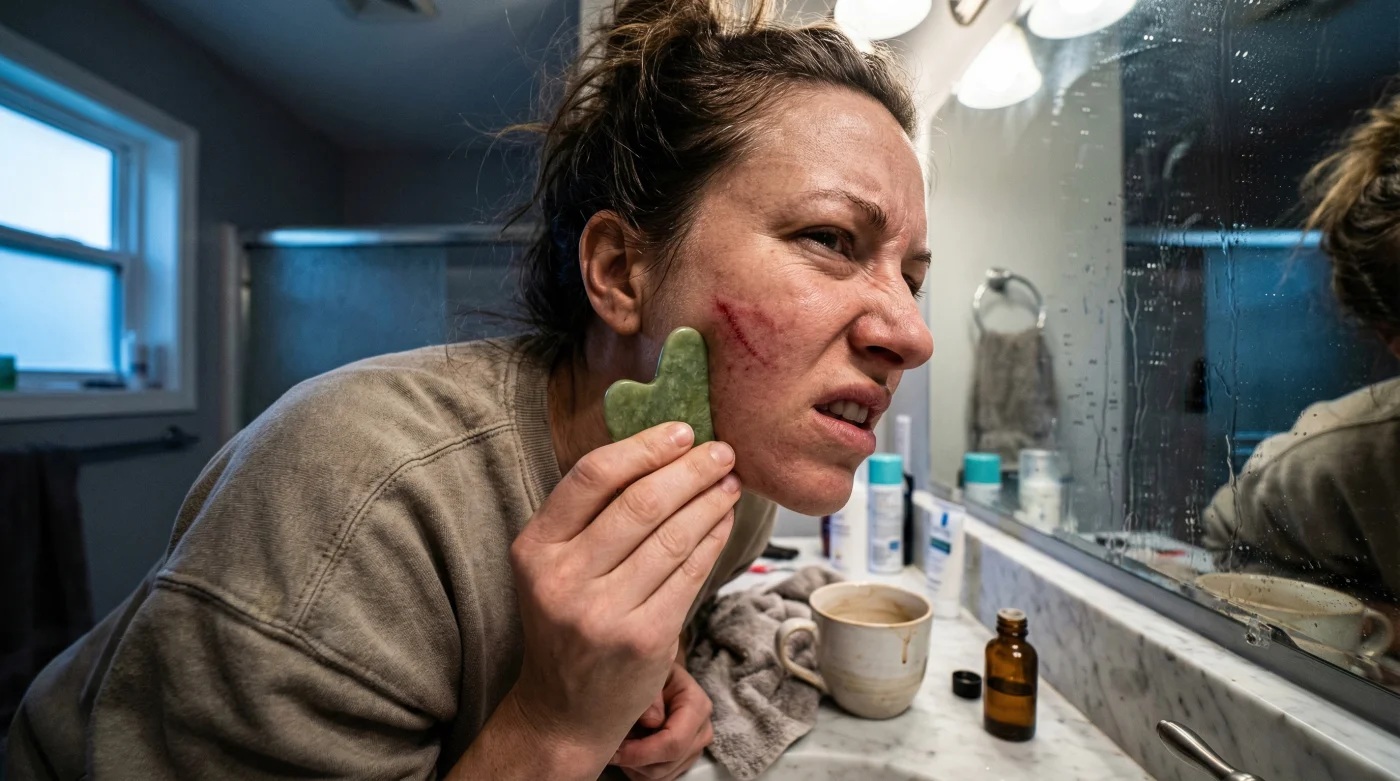
The culprit is not the massage tool itself, but a critically missing invisible barrier. Performing this highly popular facial massage technique on bare skin does not merely fail to deliver the desired contouring results; it actively creates invisible microscopic wounds across the dermis. This reckless habit permanently alters the skin’s structural integrity, accelerating the loss of elasticity and demanding an immediate, scientifically-backed overhaul of your daily regimen.
The Hidden Danger of Dry Scraping
When you glide a rigid, unforgiving stone over the face, you are applying intense sheer force to the delicate stratum corneum, the outermost layer of your skin. Without adequate lubrication, the friction coefficient skyrockets to dangerous levels. Gua Sha tools are historically designed to manipulate the underlying fascia and stimulate deeply rooted lymphatic drainage pathways, but they were never intended to drag across unlubricated, bare skin. Dermatological experts confirm that this aggressive, high-friction dragging action physically stretches the facial elastin fibres beyond their natural yield point, causing them to snap and degrade prematurely.
Over a period of mere weeks, this repeated mechanical stress leads to irreversible micro dermal scarring. You might not see these microscopic tears with the naked eye immediately, but the cumulative damage fundamentally disrupts the critical skin barrier. This disruption leads to massive transepidermal water loss (TEWL) and a state of persistent, low-grade inflammation. Experts advise that treating the delicate facial skin with such hostility actually accelerates the breakdown of existing collagen networks, delivering the exact opposite of what the contouring trend promises. Identifying the physical signs of this trauma is essential before irreversible laxity sets in.
Symptom = Cause: Diagnostic Troubleshooting
- Symptom: Persistent flush or erythema lasting hours post-massage = Cause: Severe disruption of the superficial capillary network due to high-friction dragging on a dry epidermis.
- Symptom: New onset of milia, micro-comedones, or rough, bumpy texture = Cause: Invisible micro-tears healing poorly, effectively trapping keratin and bacteria under the surface of the compromised skin barrier.
- Symptom: A crepey, prematurely aged, paper-like texture around the high cheekbones = Cause: Chronic mechanical stretching and snapping of elastin fibres without a protective lipid slip agent to absorb the shear force.
Recognising these alarming physiological responses is the essential first step towards rectifying the dermal damage and optimising your daily contouring technique.
| Approach | Target Audience | Primary Effects & Benefits | Long-Term Outcome |
|---|---|---|---|
| Dry Gua Sha Scraping | Uninformed beginners & rushed routines | Immediate redness, minor swelling mimicking temporary plumpness | Permanent micro-dermal scarring, severe barrier degradation, premature laxity |
| Water or Toner Base | Oily skin types seeking a lightweight, non-greasy feel | Rapid evaporation, leading to unexpected mid-routine friction | Inconsistent glide, patchy erythema, broken capillaries |
| Dedicated Facial Oil (e.g., Rosehip) | Anti-ageing enthusiasts & professionals, all skin types | Flawless glide, lipid barrier fortification, deep fascia release | Sharply contoured jawline, enhanced dermal elasticity, zero tearing |
- Gua Sha routines without facial oil cause permanent micro dermal scarring
- At 50 stop using chemical SPF 50 and switch to mineral
- Snail mucin on dry skin accelerates aging instead of adding moisture
- Wash off your micellar water immediately to stop severe barrier damage
- Vitamin C serum applied after moisturizer blocks overnight skin repair entirely
The Science of Dermal Friction and Micro-Tearing
The biological structure of the human face is remarkably thin and fragile, particularly around the periorbital (eye) and jawline regions, where the skin measures a mere 0.5 millimetres in thickness. Dragging a dense jade, stainless steel, or rose quartz stone across this vulnerable surface generates a profound amount of frictional heat and mechanical shear stress. The primary biological objective of Gua Sha is to actively stimulate the lymphatic system to drain stagnant, toxin-filled fluid and to release chronic tension within the mimetic muscles. However, to successfully bypass the superficial epidermal layers and reach the deeper muscle tissue safely, the heavy tool must glide with absolute zero resistance.
Clinical observations and friction analyses reveal that a dedicated slip agent, specifically a high-quality, nutrient-dense facial oil, dramatically lowers the skin’s friction coefficient to near zero. This chemical intervention allows the downward pressure to transfer safely into the underlying muscle tissue rather than horizontally dragging across the fragile epidermis. Without this vital lipid layer, the horizontal shear force literally rips the intercellular lipids apart, compromising the skin’s immune function. Precision application of the correct botanical medium is non-negotiable for anyone serious about anti-ageing.
| Substance / Mechanism | Friction Coefficient on Human Skin | Dosing / Application Volume | Dermal Protection Level |
|---|---|---|---|
| Bare Skin (Dry) | 0.45 – 0.70 (Extremely High Shear Stress) | None (0 ml) | Critical Danger (Actively causes micro-tears and snaps elastin) |
| Hyaluronic Acid Serum | 0.25 – 0.35 (Moderate, features a sticky dry-down phase) | 1-2 pumps (approximately 0.5 ml) | Insufficient (Requires constant reapplication and misting) |
| Cold-Pressed Rosehip Oil | 0.05 – 0.10 (Ultra-smooth, prolonged glide) | 3-5 drops (approximately 0.2 ml) | Optimal Protection & Cellular Repair |
| Pure Squalane Oil | 0.04 – 0.08 (Biomimetic, frictionless slip) | 4 drops (approximately 0.15 ml) | Exceptional Protection, strictly for Acne-Prone & Reactive Skin |
Precision Dosing and Application Protocol
Using the precise volume of oil is paramount to achieving a clinical-grade result at home. Dermatological experts advise dispensing exactly 0.2 millilitres (roughly 3 to 4 drops) of a rich, unrefined facial oil directly into the palms of the hands. The thermal activation of this lipid is vital: vigorously rub your hands together for ten seconds to warm the oil to approximately 37 Degrees Celsius, matching your core body temperature. This crucial thermal shift decreases the oil’s baseline viscosity, allowing it to rapidly coat the epidermis in a microscopic, uniform protective layer rather than sitting in heavy, unabsorbed pools.
Press the thermally activated oil firmly into the face, neck, and décolletage, ensuring every single millimetre of skin that will encounter the stone is thoroughly lubricated. Wait exactly 60 seconds before beginning your massage to allow the initial lipid absorption to stabilise the compromised barrier. Mastering this delicate chemical and mechanical balance naturally leads to the vital question of which specific botanical slip agent will yield the most dramatic contouring results without risking severe acne breakouts.
Choosing the Ultimate Slip Agent for Contouring
Not all oils are created equal when it comes to the rigorous demands of deep facial massage. Heavy, highly comedogenic oils like raw coconut or synthetic mineral oil may provide an adequate initial glide, but they severely occlude the pores, trapping the very cellular toxins and stagnant fluids your lymphatic massage is attempting to clear out. The absolute golden standard for optimal Gua Sha practice is a biologically compatible, nutrient-dense lipid like cold-pressed rosehip seed oil. Rosehip oil is naturally abundant in tretinoin (a highly bioavailable form of Vitamin A) and crucial essential fatty acids, which actively repair the lipid barrier and stimulate collagen synthesis whilst you perform the massage.
For individuals struggling with highly reactive, sensitive, or acne-prone skin, pure sugarcane-derived squalane serves as an exceptional, scientifically proven alternative. Because highly refined squalane closely mimics the skin’s naturally produced sebum, it is instantly recognised by the sebaceous glands. This biomimetic property provides an immaculate, frictionless surface without triggering comedone formation or follicular congestion. The ultimate goal is ensuring the chosen oil remains fluid and workable for the entire 5 to 10-minute duration of your contouring programme.
| Quality Indicator | What to Look For (The Gold Standard) | What to Avoid (The Red Flags) |
|---|---|---|
| Extraction Method | Cold-pressed, unrefined (crucial for retaining volatile antioxidants) | Heat-extracted or chemically refined (destroys fragile botanical nutrients) |
| Ingredient Purity | 100% pure single-origin oil (e.g., pure Rosa canina seed oil) | Added synthetic fragrances, heavy silicones (e.g., Dimethicone), or fillers |
| Viscosity & Slip | Medium weight, fully absorbs within 15 minutes post-massage | Flash-drying synthetic formulas or heavy, sticky, non-absorbing mineral waxes |
| Packaging & Storage | Dark amber, cobalt, or UV-protective heavy glass bottle | Clear plastic bottles (allows rapid UV oxidation and rancidity of delicate lipids) |
The Ultimate 3-Step Contouring Routine
- Step 1: The Purified Canvas. Always begin your programme with a meticulously cleansed face. Use a gentle, pH-balanced cleanser to entirely strip away urban pollution, excess sebum, and dead skin cells. Never perform a massage on unwashed skin, as the intense mechanical friction will aggressively drive surface bacteria deep into the follicular ostia, guaranteeing cystic breakouts.
- Step 2: The Lipid Armour. Apply your precisely measured 0.2 ml of body-temperature rosehip or squalane oil. Gently but firmly press it into the primary lymphatic drainage pathways: working down the sides of the neck, sweeping along the jawline, and pushing upwards across the high points of the cheeks.
- Step 3: The 15-Degree Glide. Hold your heavy Gua Sha tool almost entirely flat against the skin at a shallow 15-degree angle, never at a harsh 90-degree scraping angle. Use feather-light, intentional pressure, allowing the natural weight of the stone and the frictionless slip of the oil to do all the mechanical work. Drag gently outward and downward to effectively flush the stagnant lymphatic fluid heavily towards the collarbones.
By treating the skin’s surface with profound biological respect and relying exclusively on superior botanical oils, you can successfully transform a potentially damaging daily habit into a genuine masterclass in structural facial rejuvenation.