For decades, the pursuit of a flawless, radiant complexion has harboured a devastating ecological and dermatological secret. Millions of us stand in front of our bathroom mirrors every morning, dutifully massaging our favourite exfoliating washes into our pores, completely unaware that this deeply ingrained habit is flushing tonnes of indestructible, invisible pollutants directly into British waterways. This seemingly innocent ritual does not just suffocate aquatic life; the jagged, irregular shapes of these cheap synthetic additives create microscopic fissures in the delicate human skin barrier, accelerating the very premature ageing and inflammation we are desperately trying to scrub away.
Now, a monumental industry earthquake has just rendered thousands of competitor products instantly obsolete. In a sweeping, record-breaking policy shift, an iconic global beauty powerhouse has drawn a definitive line in the sand, aggressively phasing out a ubiquitous, synthetic ingredient that has plagued face washes for a generation. By replacing these damaging spheres with scientifically calibrated, naturally derived alternatives, L’Oreal has not only established a ground-breaking new benchmark for planetary health but has fundamentally revolutionised how we will achieve genuinely healthy, glass-like skin from this day forward.
The Epidemic of Micro-Tears and Marine Pollution
To truly grasp the magnitude of this industry overhaul, one must understand the silent damage inflicted by traditional synthetic scrubs. Historically, the cosmetics sector relied heavily on Polyethylene and Polypropylene plastics to create the abrasive textures required to dislodge dead skin cells. These synthetic microbeads were favoured purely for their incredibly low manufacturing cost, not for their dermatological efficacy. Consequently, consumers have been unknowingly subjecting their faces to harsh, non-degradable polymers that offer zero nutritional benefit to the Stratum corneum, the skin’s outermost protective layer.
Clinical dermatologists have long raised concerns regarding the mechanical trauma caused by these synthetic particles. When massaged into the face, especially with aggressive pressure, they strip away vital lipids and induce low-grade, chronic erythema. Identifying if your current routine is fundamentally damaging your skin requires strict observation of post-wash reactions. Consider this diagnostic breakdown of common exfoliation warning signs:
- Symptom: Persistent facial redness lasting over 20 minutes post-wash = Cause: Micro-tears from jagged Polyethylene plastics breaching the acid mantle.
- Symptom: Sudden onset of adult acne and unexpected breakouts = Cause: Compromised barrier function allowing Cutibacterium acnes bacteria to penetrate deeper epidermal layers.
- Symptom: Uncomfortable tightness and a ‘squeaky clean’ sensation = Cause: Complete depletion of natural ceramides due to overly aggressive synthetic friction.
- Symptom: Heightened sensitivity to standard moisturisers or vitamin C serums = Cause: Invisible abrasions acting as open wounds, drastically lowering the skin’s tolerance threshold.
By eradicating these archaic synthetics, the immediate benefits cascade across various skin types and demographic profiles. The transition to botanical and mineral-based alternatives offers a tailored, restorative approach rather than a universal assault on the complexion.
| Target Audience | Historical Issue with Synthetics | Clinical Benefit of the Natural Shift |
|---|---|---|
| Mature / Ageing Skin | Micro-tears accelerating transepidermal water loss. | Enhanced moisture retention and gentle cellular turnover without structural damage. |
| Acne-Prone / Congested Skin | Spreading bacteria through aggressive surface scratching. | Targeted pore refinement using uniform, non-abrasive natural minerals. |
| Highly Sensitive / Rosacea-Prone | Immediate flare-ups and intense vascular inflammation. | Soothing, predictable exfoliation using naturally dissolving botanical sugars. |
| Eco-Conscious Consumers | Guilt associated with contributing to marine microplastic pollution. | Complete peace of mind with 100 percent biodegradable, sustainably sourced particles. |
Understanding the true physiological and environmental damage of these invisible pollutants makes the urgency of the industry’s latest pivot entirely undeniable.
How L’Oreal is Rewriting the Rulebook
Setting a timeline that severely outpaces basic regulatory compliance, L’Oreal has executed an aggressive, global phase-out programme. While the UK government previously introduced legislation banning rinse-off microbeads, this corporate initiative expands the philosophy globally across all manufacturing territories, encompassing a wider array of formulas and product categories. The brand’s research and development laboratories have spent thousands of hours engineering the perfect suspension systems to support a new generation of raw, earth-derived materials.
- Gua Sha routines without facial oil cause permanent micro dermal scarring
- At 50 stop using chemical SPF 50 and switch to mineral
- Snail mucin on dry skin accelerates aging instead of adding moisture
- Wash off your micellar water immediately to stop severe barrier damage
- Vitamin C serum applied after moisturizer blocks overnight skin repair entirely
The Top 3 Natural Exfoliation Upgrades
- 1. Volcanic Perlite: Derived from volcanic glass, this naturally occurring mineral is expanded through intense heat to create ultra-lightweight, perfectly spherical particles. It acts as an exceptionally gentle buffer, absorbing excess sebum while polishing away dullness without scratching the tissue.
- 2. Apricot Kernel Powder (Prunus armeniaca): A highly sustainable by-product of the food industry. When milled to an exact specification of 50 to 100 micrometres, it provides a satisfying, granular sweep that stimulates superficial blood circulation, enhancing that coveted post-wash glow.
- 3. Fine-Milled Sugars and Salts: Utilised in heavier body scrubs, these crystalline structures possess a unique self-regulating mechanism. As they mix with water and body heat, their edges naturally soften and dissolve, making it physically impossible to over-exfoliate the skin barrier.
The technical supremacy of these natural agents is not merely anecdotal; it is deeply rooted in measurable, biochemical properties that dictate how products interact with both human tissue and the broader ecosystem.
| Exfoliant Material | Average Particle Size | Mechanism of Action | Environmental Degradation Time |
|---|---|---|---|
| Synthetic Polyethylene (Obsolete) | 10 to 1000 micrometres (Highly Irregular) | Jagged mechanical abrasion; high risk of epidermal tearing. | Up to 500+ years in marine environments. |
| Volcanic Perlite | Approx. 75 micrometres (Spherically Milled) | Mild buffing and high lipid absorption; preserves the acid mantle. | Naturally integrating earth mineral (Zero pollution). |
| Apricot Kernel Extract | 50 to 100 micrometres (Smooth edged) | Physical sweeping of desquamated cells; stimulates microcirculation. | Less than 30 days (Fully compostable). |
With the raw science confirming the undisputed superiority of these naturally derived minerals and botanicals, the focus now shifts entirely to applying these formulations correctly within your personal daily regimen.
Mastering the Art of Clinical Exfoliation
Owning a technologically advanced, microplastic-free scrub is only the first part of the equation; executing the application with clinical precision is what truly transforms the skin. Experts advise that mechanical exfoliation should be treated as a targeted weekly treatment, rather than a mindless daily habit. The goal is to assist the skin’s natural desquamation process, not to forcefully strip away living tissue.
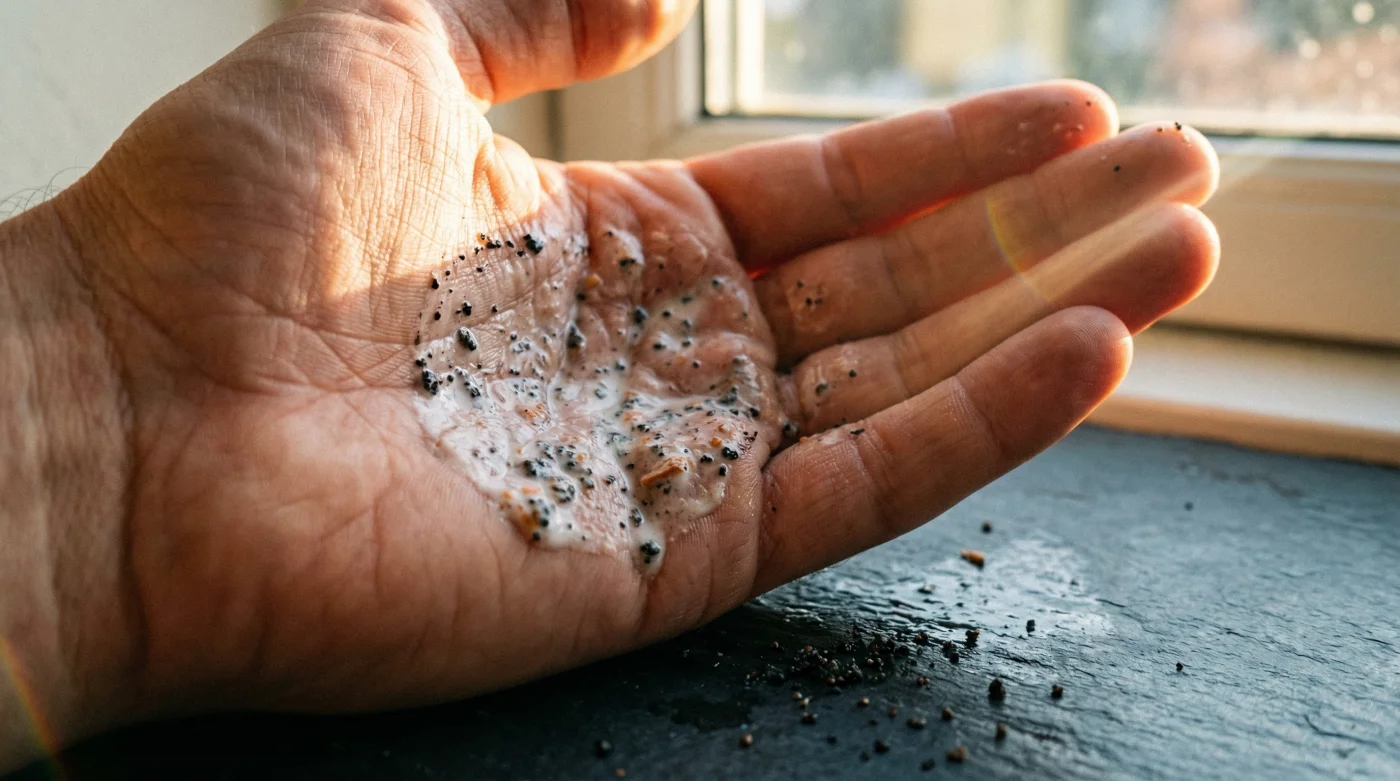
To achieve professional-grade results at home, strict dosing and environmental controls must be observed. Dispense exactly 2.5 grams (roughly the size of a 10 pence piece) of your chosen L’Oreal natural scrub into the palm of your hand. The temperature of your water is absolutely critical; it must be lukewarm, ideally calibrated around 37 degrees Celsius. Water that is too hot will strip epidermal lipids, whilst water that is too cold will cause pores to contract, trapping the very debris you are attempting to remove. Apply the product using only the pads of your ring and middle fingers, employing weightless, upward circular motions for precisely 60 seconds. Rinse thoroughly and immediately follow with a ceramide-rich moisturiser to lock in hydration and fortify the freshly exposed barrier.
As you navigate the aisles of your local pharmacy or high-street beauty retailer, you must become a discerning label reader, ensuring you are purchasing a product that meets these new, elevated industry standards.
| Quality Marker | What to Look For (The Gold Standard) | What to Avoid (The Red Flags) |
|---|---|---|
| Ingredient Nomenclature | Perlite, Prunus armeniaca seed powder, Sucrose, Maris sal. | Polyethylene (PE), Polypropylene (PP), Polymethyl methacrylate (PMMA). |
| Texture Profile | Uniform, fine, almost sand-like consistency suspended in a hydrating gel or cream base. | Suspended, brightly coloured plastic beads of varying, jagged sizes. |
| Dosing Recommendations | Clear instructions advising usage of 1 to 2 times per week maximum. | Aggressive marketing suggesting ‘vigorous daily scrubbing’ for clear skin. |
| Sustainability Certifications | FSC-certified packaging, clear biodegradability statements, cruelty-free logos. | Absence of any environmental transparency or sourcing information. |
Armed with these stringent quality criteria, transforming your bathroom cabinet into a safe, efficacious haven becomes a precise, risk-free science.
Future-Proofing Your Skincare Investment
The era of sacrificing our oceans for a fleeting, superficial glow is officially over. The decisive action taken by L’Oreal serves as a monumental wake-up call to the entire cosmetic industry, proving that ecological responsibility and elite dermatological performance are not mutually exclusive. By embracing formulations that leverage the natural abrasive power of perlite, seeds, and sugars, consumers are actively participating in a global environmental clean-up whilst simultaneously treating their skin with the clinical respect it deserves.
Ultimately, the health of your skin barrier and the purity of British waterways are intrinsically linked by the choices you make at the sink. Audit your current skincare repertoire today. Discard the obsolete synthetic plastics, invest in scientifically proven botanical exfoliants, and adhere to precise, gentle application techniques. The result will be a dramatically refined, resilient complexion that stands the test of time, backed by an industry standard that finally puts both people and the planet first.