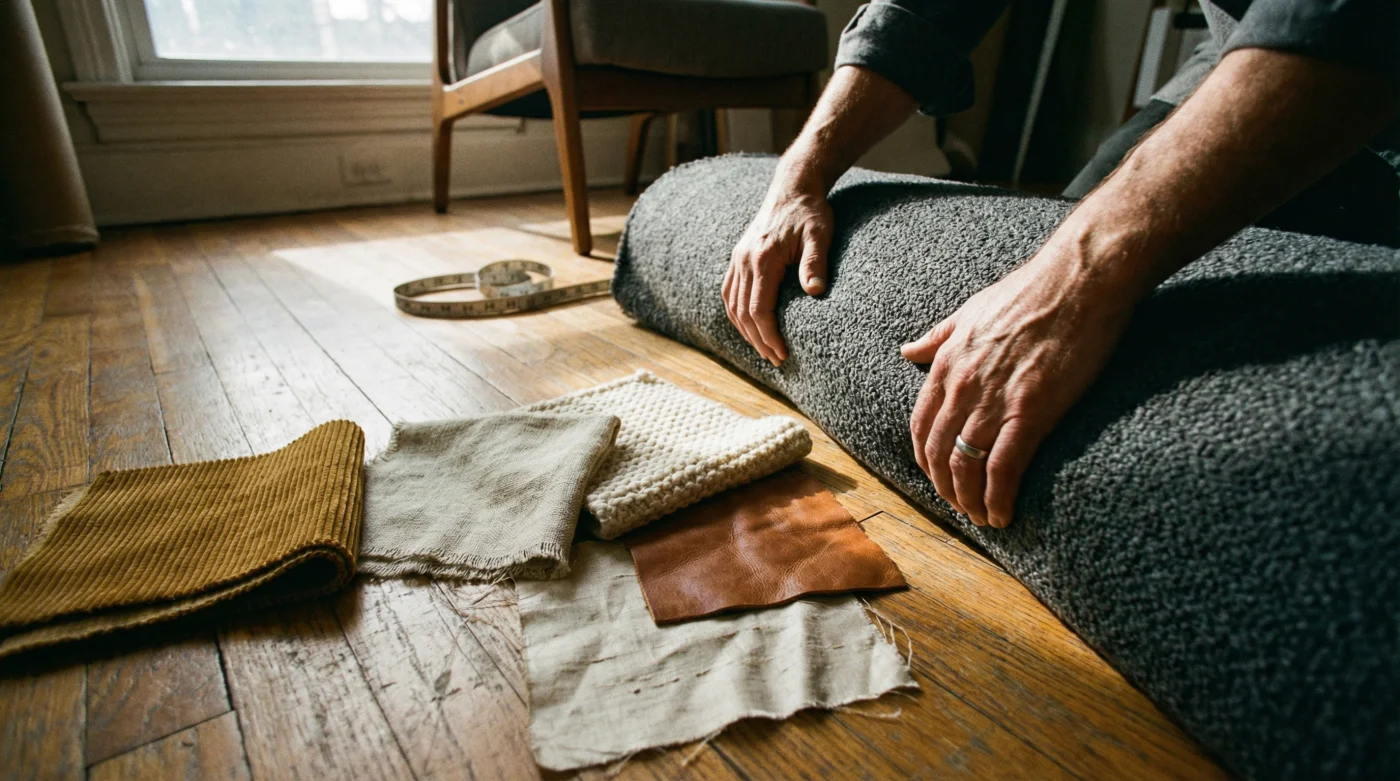
It begins innocently enough: a plush velvet armchair from the high street, a boucle throw for the chilly British evenings, and perhaps a rattan side table to add a touch of the organic. But suddenly, your living room doesn’t feel curated; it feels chaotic. There is a precise tipping point between ‘eclectic masterpiece’ and ‘jumble sale’, and leading interior designers have finally put a hard number on it. That number is five.
The moment you introduce a sixth distinct texture into a standard UK living space, the eye loses its ability to rest. The room shrinks, visually collapsing under the weight of too much sensory information. The secret to that effortless, high-end magazine look isn’t piling on more scatter cushions; it is stopping abruptly at five finishes and pivoting your entire design strategy towards scale. If you are currently drowning in fabric swatches, this rule is your lifeline.
The Texture Trap: Why Less is More in British Homes
In the United Kingdom, where grey skies often dictate our design choices, the impulse is to layer for warmth. We crave the ‘cosy’ aesthetic. However, in typical Victorian terraces or modern new-build flats, square footage is at a premium. When you overcrowd a room with competing surfaces—shiny leathers, matte wools, glossy woods, rough jutes—you create visual noise that makes walls feel closer together.
The ‘Rule of Five’ suggests that a cohesive scheme needs only five distinct tactile elements to feel complete. The most critical of these in contemporary design is undoubtedly velvet furniture. Because velvet absorbs light rather than reflecting it, it adds a depth and heaviness that anchors the room, acting as the gravitational centre for the other four textures.
“Think of texture as a language. If you have ten people shouting in different accents, it’s just noise. If you have five distinct voices speaking clearly, it’s a conversation. Velvet furniture is usually the loudest voice in the room—let it speak without interruption.”
Identifying Your ‘Big Five’
To implement this strategy, you must audit your space. If you are centering the room around a piece of statement velvet furniture, such as a chesterfield or a modular corner sofa, that is your Texture #1. The remaining four should offer high contrast. A balanced British lounge might look like this:
- The Anchor (Velvet): Deep, light-absorbing, and soft. This provides the luxury and comfort factor.
- The Organic (Wood or Rattan): Adds warmth and structure. Think oak flooring or a walnut coffee table.
- The Reflective (Metal or Glass): Essential for bouncing light around grey rooms. Brass fittings or a mirror.
- The Natural Soft (Wool, Linen, or Cotton): A flat weave to contrast the pile of the velvet. Curtains or throws.
- The Hard (Stone, Ceramic, or Plaster): A fireplace hearth or sculptural vase.
Once these five are present, put the credit card away. Do not buy the sheepskin rug. Do not add the macramé wall hanging. Instead, look at the size of what you already have.
The Pivot to Scale: Blowing It Up
- Gua Sha routines without facial oil cause permanent micro dermal scarring
- At 50 stop using chemical SPF 50 and switch to mineral
- Snail mucin on dry skin accelerates aging instead of adding moisture
- Wash off your micellar water immediately to stop severe barrier damage
- Vitamin C serum applied after moisturizer blocks overnight skin repair entirely
To make a room feel expansive, you need to play with extremes. If you have a large velvet sofa, pair it with an oversized floor lamp, not a tiny table lamp. If you have a rug, it should be large enough that the furniture sits entirely on it, not floating like an island in the middle of a carpet sea.
Comparative Strategy: Texture vs. Scale
Here is how shifting your focus from adding texture to adjusting scale transforms a room:
| Design Element | The Amateur Mistake (Adding More) | The Pro Move (Adjusting Scale) |
|---|---|---|
| Velvet Furniture | Adding patterned cushions in silk and fur to ‘match’. | Choosing a sofa with a deeper seat or higher back to dominate the wall. |
| Lighting | Adding more small lamps with different shade fabrics. | Installing one massive pendant light or an over-scaled floor lamp. |
| Walls | Using textured wallpaper or gallery walls of tiny frames. | One large piece of art or a floor-to-ceiling mirror. |
| Flooring | Layering multiple small rugs (jute over carpet). | One enormous rug that extends 12 inches under the sofa. |
Mastering the Velvet Anchor
Velvet furniture is particularly sensitive to scale because of its visual weight. A small velvet chair can look pokey and cheap, whereas a large velvet ottoman looks regal. When you stop adding clutter, you allow the sheen and the pile of the velvet to catch the light properly. This is particularly effective in the UK, where natural light changes drastically throughout the day. In the morning, a large crushed velvet sofa might look bright and inviting; by evening, under artificial light, it becomes moody and dramatic.
By limiting your palette to five textures, you create negative space. This negative space allows the scale of your furniture to be appreciated. Your eye traces the long line of the sofa, the height of the curtains, and the span of the rug, rather than bouncing frantically from the sequins to the hessian to the faux fur.
FAQ: Refining Your Room
1. Does the colour of the velvet furniture matter for the texture count?
Technically, no. Texture refers to the surface quality (tactility), not the hue. However, a bright orange velvet sofa has more visual weight than a grey one. If you choose a bold colour, you might want to keep the other four textures more neutral to prevent the room from feeling overwhelming.
2. Can I mix different types of velvet?
Proceed with caution. Mixing a cotton velvet with a crushed polyester velvet can look messy. It is generally safer to stick to one type of velvet furniture as your primary texture and use wool or linen as your secondary soft texture. This creates a cleaner, more deliberate contrast.
3. What if my room feels cold with only five textures?
If the room feels cold, do not add a sixth texture. Instead, increase the amount of the ‘warm’ textures you already have. Swap a small wool throw for a giant, heavy-knit wool blanket. Swap a small timber side table for a large solid oak coffee table. It is a scale issue, not a variety issue.
4. How do I apply this to a small box room?
In a small room, scale is even more critical. A common myth is that small rooms need small furniture. In reality, one large velvet armchair is better than two small stiff chairs. Use fewer, larger pieces to trick the eye into thinking the space is generous.